+1-330-628-3012
 info@iaitam.org
Data sanitization is a lifecycle responsibility for ITAMs, requiring standards-driven, verifiable processes to reduce data risk and ensure compliance.
By: Namrata Sengupta, BitRaser
Data sanitization is no longer an end-of-life checkbox. It is a continuous responsibility across the entire IT asset lifecycle that every ITAM function must own. Data often outlives the assets that store it, and even after a device is retired, the information it once held can still create operational, financial, and regulatory risks. For this reason, data sanitization has become a foundational element of modern IT Asset Management (ITAM). Yet many organizations still treat it as a one-time activity instead of embedding it into every stage of the asset lifecycle. A recent study conducted by IBM shows that the global data breach cost has risen to 4.88 million USD, with the cost rising by 10% in just one year. This means that if a single batch of IT assets is mishandled, it can lead to a major data breach episode that can wipe out years of ITAM efficiency.
This changes the job of IT asset managers from simply tracking hardware to actively managing data risks across the asset lifecycle. Therefore, the IT asset manager must no longer work with outdated data sanitization or disorganized practices and should develop a structured, standards-driven approach to data sanitization.
The globally recognized National Institute of Standards and Technology Media Sanitization Guidelines come in handy for ITAMs with sanitization requirements clearly defined. Likewise, IEEE 2883:2022 is yet another standard that defines sanitization techniques to be used across different device types.
NIST SP 800 88 Rev 2 states that, “media sanitization refers to a process that renders access to target data on the media infeasible for a given level of effort.” In practical terms, this means ITAMs must perform data sanitization as a process that eliminates data so thoroughly that recovery is not possible even using a free or commercially available data recovery tool or in-lab services. NIST 800-88 Rev2 is widely considered a gold standard for media sanitization that is based on a risk-based approach.
IT asset managers must evaluate devices according to data sensitivity, their intended reuse, and the storage technology being utilized by the device before selecting a sanitization method. This ensures that sanitization decisions are consistent and align with modern data protection requirements.
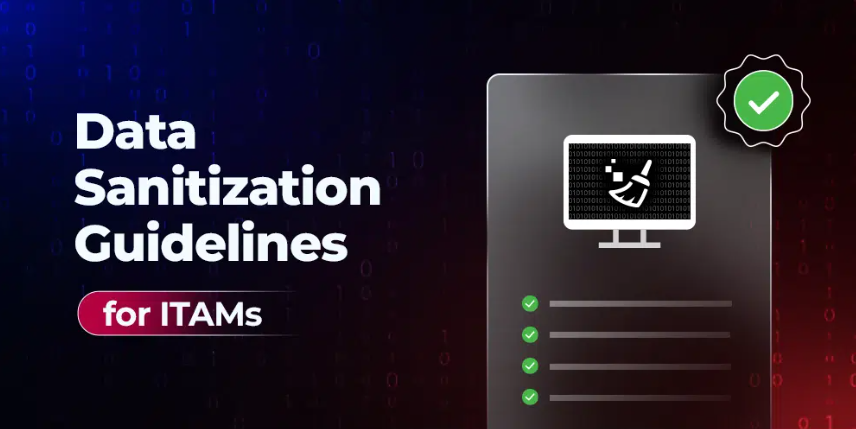
Data Sanitization Guidelines for ITAMs
IT asset managers need to follow data sanitization guidelines that align with modern standards based on data classification and device reuse strategies. These guidelines are built around real-world risk, modern technologies, and verifiable outcomes that help significantly reduce data exposure while preserving asset value.
• Implement Data Sanitization Program: ITAM must ensure that the data sanitization program is implemented across branches and locations. It must be governed through a formally defined program rather than treated as an isolated end-of-life activity. A recognized sanitization program ensures consistency in decision-making and accountability across the organization. Effective ITAM governance must therefore define clear ownership for sanitization decisions, document workflows for onsite and offsite sanitization, and ensure that sanitization activities are aligned with recognized standards such as NIST SP 800 88 Rev 2 or IEEE 2883:2022. In the policy, every asset must be mapped to a sanitization method.
o Clear: For reuse within the organization, whether for reallocation or internal redeployment.
o Purge: Techniques like Cryptographic Erase or Secure Erase should be used for assets leaving the organizational control, whether it’s for reuse or return.
o Destroy: Physically destroy the media when reuse is impossible, or data security risk is extreme. This includes failed drives with highly sensitive data or physically damaged drives.
• Choose the Right Data Sanitization Standard: Properly choosing the correct data sanitization standard is very important for compliance and audit readiness. NIST SP 800-88 Rev. 2 offers a contemporary framework that surpasses basic media-specific wiping techniques to adopt a systematic, programmatic approach to sanitization, with a focus on data sensitivity, device reuse decisions, and quantifiable results.
Since NIST SP 800-88 Rev. 1 has been superseded, IT Asset Management teams should revise policies and procedures to meet current guidance. NIST SP 800-88 Rev. 2 also refers to IEEE 2883 for detailed media-specific sanitization instructions and introduces the requirement for sanitization validation. That will require ITAM teams to verify each sanitization method as successful or failed, rather than procedural verification only.
• Account for Modern Storage Technologies: Modern storage technologies have introduced significant challenges for data sanitization. Hard disk drives and solid-state drives are built on fundamentally different architectures. Even within magnetic drives, the storage architecture differs between Conventional Magnetic Recording and Shingled Magnetic Recording drives.
Basis the technology, the choice of data sanitization method, like overwriting and firmware-based commands (Secure Erase, Block Erase) should be made. Cryptographic erasure should be preferred for Self-Encrypting Drives. Overwriting is not reliable for SSDs. SSDs use wear leveling, garbage collection, and flash translation layers that manage the mapping between logical block addresses and physical flash memory locations. So, many data blocks may remain untouched when an overwrite is conducted. Due to this fact, NIST SP 800 88 Rev 2 strongly recommends Cryptographic Erase or device supported purge commands for SSDs. Cryptographic erase works by removing or replacing the media encryption key, rendering all existing data permanently inaccessible.
• Perform Verification & Audit: Without verifiable evidence of sanitization, the process remains incomplete from a compliance and audit perspective. ITAMs must maintain data destruction records and perform random audits to validate the efficacy of the sanitization process. NIST SP 800 88 Rev 2 places specific emphasis on sanitization validation, requiring ITAM teams to confirm that the chosen method successfully renders data unreadable.
• Track Chain of Custody: IT asset managers must track every movement of the data-bearing device (From Decommissioning > Pick up > Transit > Warehousing > Processing). The chain of custody document should be maintained with a time stamp, location details, and the person responsible. Signed forms or digital acknowledgements at each transfer are a must.
• Govern ITAD Vendors or Third-Party Service Providers: For many ITAM teams, third-party vendors perform media sanitization. IT asset managers need to treat them as part of their controlled environment. They should check service providers’ certification (Example, R2, e-Stewards) and review their data sanitization processes along with a certificate of destruction. Periodic or random monitoring helps in reducing risks.
• Employee Training: Staff training is necessary because human errors are still a leading cause of data breaches. Regular training for new and old staff must be organized to help them distinguish between deletion and sanitization techniques. Audits help to ensure that processes are kept up to date according to evolving standards and technologies, offering tangible evidence of the destruction of private data.
Conclusion
Implementing the best practices of media sanitization right from the device procurement stage to its disposal helps mitigate data breach risks. IT asset managers must establish a forward-looking sanitization strategy that balances compliance, operational risk, and sustainability objectives. This includes abiding by a data sanitization policy that is aligned with NIST guidelines and organizational privacy obligations. Classifying asset types and mapping the appropriate sanitization method, with automated reporting for audit purposes, is essential. For IT asset managers, the real risk is no longer whether data is erased, but whether sanitization decisions can stand up to scrutiny months or years later.